The Educational and Vocational Services Department offers offenders learning experiences that can help them change their lives for the better. In addition to our Adult Basic Education program that allows students to work toward their high school credential, we also offer an Advanced Education course and a College Readiness program in which students may learn about how to successfully navigate higher education.
The Chapter 766 Program provides special education services to offenders who are between the ages of 18-22 and have a current Individual Education Plan (IEP). This program is intended for inmates who possess neither a high school diploma nor a high school equivalency credential. Eligible individuals receive small group or private instruction based on educational background and ability. The computer-assisted classroom instruction is geared to encourage the achievement of students’ goals. This program is administered by Special Education in Institutional Settings (SEIS), an agency of the Department of Education.
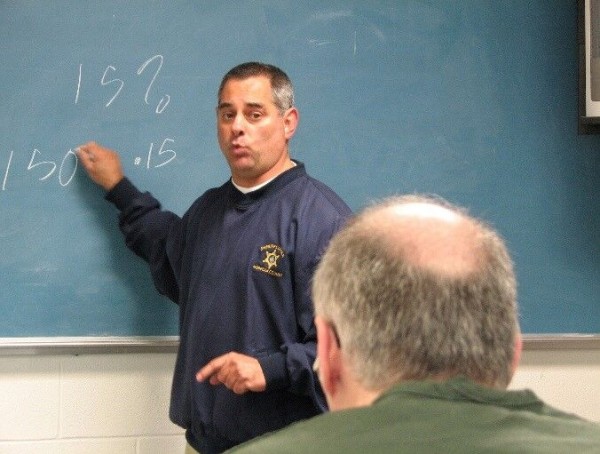
The Adult Basic Education program is offered by staff and qualified volunteers to offenders who, when tested, have not achieved a level necessary for successful High School Equivalency program completion. In this program, more emphasis is spent on attempting to raise the basic mathematics and English skills on an individual basis.
The Chapter 452 functional literacy program is offered to all offenders serving a sentence of more than sixty days. The offenders are given the opportunity to take an assessment test to determine individual instructional needs and current levels of performance to ensure proper placement in educational programming. Offenders who test below an eighth-grade reading level shall participate in educational programming for no less than ninety days. Offenders who refuse to be tested are asked to sign a refusal form to be submitted to the Parole Board. Chapter 452 requires that the Parole Board be notified of those offenders who are and are not in compliance with Chapter 452. Any offender who refuses to test is prohibited from participating in any other educational programming. An offender may request reconsideration for testing at any time during incarceration.
The High School Equivalency program is offered to offenders who wish to receive high school equivalency credential studies while confined in the facility. Success in this program is achieved by daily attendance at formal mathematics and English classes where, depending on the individual's needs, a student is permitted to work at his own speed and level. The high school equivalency examination is administered free of charge to offenders.
This program is in partnership with the Massachusetts Institute of Technology (MIT) to offer students the opportunity to participate in college courses. Interdisciplinary Studies will focus on communication, leadership, and project management. Students can take this course congruent to previous studies or switch majors without losing credit.
Offerings include, but are not limited to…
Organizational Communication (CMN100): This is a 3-credit course offered over the span of 7.5 weeks. Students will learn effective communication for organizations as well as a wide variety of employment skills. Psychological, sociological, and communication theories and their relation to organizational life will also be covered.
College Writing 1: This program gives students the necessary tools to produce high-level professional college writing. Reading, researching, and critical thinking will all be used to produce literature.
This program is designed to help student offenders gain a facility in reading texts and various printed materials with which they come in contact. Emphasis is placed on developing reading comprehension, vocabulary, and study skills. This program meets the needs of those offenders who want to be in compliance with Chapter 452 (adult basic education).
This education program is an ongoing course for both sentenced and pre-trial offenders. The Subject Tutoring Program helps individuals develop subject-specific skills and strategies to become more efficient learners.
This is an eight-week course that focuses on effective communication as it relates to writing. Participants will read and listen to historical literature to find different means of effective communication. Based on their findings, offenders will write with their new sense of effective communication to express and share their ideas.
The Civics course provides offenders with an understanding of United States citizenship and the foundations and operations of the government. Participants will learn how to be informed and engaged citizens.
The ESL program is offered to offenders who wish to improve their command of the English language. NSO staff and volunteers facilitate this weekly program that meets once to three times per week.
This eight-week course prepares individuals to make appropriate decisions in managing their personal finances and enhancing their money management skills. This class focuses on learning how to budget money, how to open and maintain a savings and checking account, and how to obtain and analyze credit records.
The Credit/Debt Recovery program works with offenders to better understand their finances and how to manage them. This course provides participants with the skills to budget, pay bills, and organize expenses. How to pay off debt. Offenders will be prepared for financial obligations post-release.
The goals of Book Club include expanding an individual’s appreciation and understanding of a common text, extending the participants’ thinking process and interpret the perspectives and opinions of their peers, and expanding their ability to express ideas orally using academic language. During Book Club, participants meet in small groups to discuss a book that they have all read or listened to.
The Public Speaking and Communication course helps participants build public speaking skills and confidence. Offenders will learn about verbal and nonverbal aspects of communication and different methods of presentation. Participants will also critique and apply constructive criticism to future work, improving overall speech and communication quality.
Offenders are given the opportunity to engage in 2-hour per week visits to the library. Individuals are encouraged to check out one book a week. Access to the library is granted to those who sign-up the prior week.
The Job Prep Boot Camp course is designed to help offenders develop the skills to facilitate a strong job search with positive outcomes. This program stresses the importance of being highly motivated and able to identify and learn to deal with challenges and setbacks by utilizing effective efforts and job search resilience. Offenders will learn to identify their skills, strengths, and competencies based on appropriate transferability to targeted jobs.
The 6-week Employment Portfolio class allows inmates the opportunity to create and or gather together a package that includes a Social Security card, birth certificate, awards or certificates earned, job application, and resume. This program offers inmates not only the important acquisition of vital identification documents, but also an emphasis on the importance of organizational skills and related information.
The facility offers ongoing career counseling and placement services for offenders preparing for release to the community.
The 6-week Resume Building program provides offenders with the necessary tools to create a professional resume. Such tools include formatting, learning how to write a concise summary, and picking out one’s most admirable and marketable skills. This program is aimed to aid offenders post-release in the educational and professional world.
The Workplace Success and Soft Skills course emphasizes work ethic, attitude, communication skills, emotional intelligence, and a whole host of other personal attributes and skills crucial for employment and career success.
Entrepreneurship class encourages entrepreneurial thinking, problem-solving, and work skills, as well as an understanding of business and professional demeanor. An entrepreneurial mindset can provide a viable pathway for offenders toward future economic opportunities including the skills needed to succeed in securing employment or creating one’s own entrepreneurial pathway. Participants will focus on the values they’ll need to be successful entrepreneurs.